


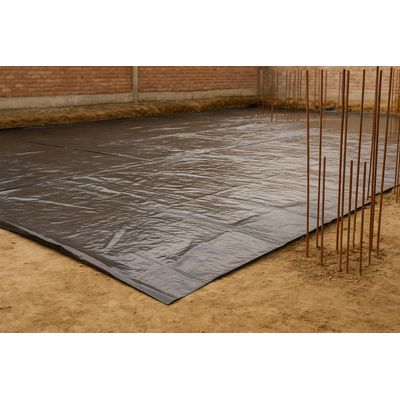
LDPE Liner in Construction: Moisture Barrier Solution
In modern construction, subgrade protection, moisture control, and soil interaction management determine the durability and service life of structures. While reinforced cement concrete provides structural strength, it remains vulnerable to moisture ingress, capillary rise, and subsoil contamination, particularly in fine-grained alluvial soils typical of Siwan, Bihar. For this project, Ocean LDPE Liner (125 micron) was deployed as a geomembrane barrier beneath foundational and flooring elements to create an effective vapor barrier, prevent water migration from subgrade, and support long-term performance.
Project specifics
Location: Siwan, Bihar. Product Used: Ocean LDPE Liner – 125 Micron. Quantity: 22,145 kg.
Engineering role of LDPE liners in building construction
LDPE liners provide flexibility, chemical resistance, and impermeability, enabling them to function as critical separation and barrier layers in the geotechnical system. Key functional applications include:
- Vapor Barrier Systems: Prevent upward moisture movement from soil into concrete slabs
- Subgrade Separation Layer: Prevent mixing of soil and construction layers
- Waterproofing Support Layer: Enhance performance of concrete and flooring systems
- Temporary Containment: Used in curing zones and protection layers
LDPE geomembranes are particularly effective in low-load applications where flexibility and installation ease are critical. The American Concrete Institute notes that moisture-related deterioration accounts for approximately 70% of durability issues in concrete structures, including cracking, reinforcement corrosion, and surface degradation.
Geosynthetics in broader infrastructure context
Geosynthetics, including geomembranes, geotextiles, geocomposites, and geogrids, have become foundational elements in modern civil engineering. Representative applications include:
- Soil Stabilization: Separation layers improve load distribution and reduce subgrade failure in weak soils
- Pavement Engineering: Reducing rutting, cracking, and water infiltration to extend pavement life by up to 30–40%
- Drainage Systems: Geocomposites and drainage layers support subsurface water flow and reduce hydrostatic pressure
- Erosion Control: Slope stabilization and soil retention in monsoon-prone regions
- Environmental Protection: Containment in landfills, ponds, and wastewater systems to prevent soil and groundwater contamination
Site-specific challenges in Siwan, Bihar
The local geotechnical profile comprises fine-grained alluvial soils with high moisture retention, low shear strength, and settlement susceptibility. Capillary rise promotes upward water migration, contributing to damp floors, reduced concrete durability, and potential reinforcement corrosion. Seasonal and monsoon rainfall further saturate subgrades and reduce bearing capacity. The LDPE liner acts as a capillary break layer, mitigating moisture migration and protecting structural components.
Installation methodology and quality control
Performance depends on disciplined installation and QA/QC. Key steps include:
- Subgrade preparation: Debris removal, proper grading, compaction, and smooth surface
- Liner placement: Unroll carefully to avoid wrinkles, maintain alignment, ensure adequate sheet overlaps
- Jointing and seaming: Seal overlaps to prevent seepage; adhesive bonding or heat sealing per site conditions
- Protection during construction: Shield from reinforcement bars and equipment; use protective layers where required
Long-term performance and durability considerations
LDPE liners, while thinner than HDPE geomembranes, deliver effective performance when used appropriately. Critical factors include impermeability, flexibility to accommodate minor subgrade movement, chemical resistance to mild soil contaminants, and thermal stability under moderate temperature variation. With protection from UV exposure and mechanical damage, LDPE liners can provide durable performance within subgrade systems.
Maintenance and lifecycle benefits
Incorporating LDPE geomembranes reduces long-term maintenance through dampness control and prevention of moisture-related defects, contributing to lower repair costs, improved indoor environmental quality, and extended structural lifespan. Lifecycle analyses in moisture-protection-focused projects indicate potential maintenance cost reductions of 20–35% over a building’s life.
Conclusion
The Siwan project illustrates the value of integrating geosynthetics such as LDPE liners into foundational design for moisture control, subgrade protection, and long-term durability in challenging soil and moisture conditions.
Original: https://oceangeosynthetics.com/ldpe-liner-in-construction-moisture-barrier/