


Rehabilitation after ACL injury - Case Study
- Sporty man
- Recreational volleyball
- Post-operative rehabilitation ACL Left (week 8)
Tom suffered an ACL tear on his left leg during a volleyball match. The doctor in charge decided to proceed with an operative reconstruction of the affected ligament. Tom then immediately started a rehabilitation process to get him back on the court as soon as possible. The first few weeks were mainly spent with mobilisations and closed-chain exercises. In the following stages, careful cocontraction and flexion/extension exercises were offered. In this case we show how Matti is used to systematically make rehabilitation more challenging. Research has already shown that commercial exergames are able to achieve similar results to conventional therapy [1]. Through the specific adaptations that can be made via the Matti system, Tom can be monitored and challenged even better.
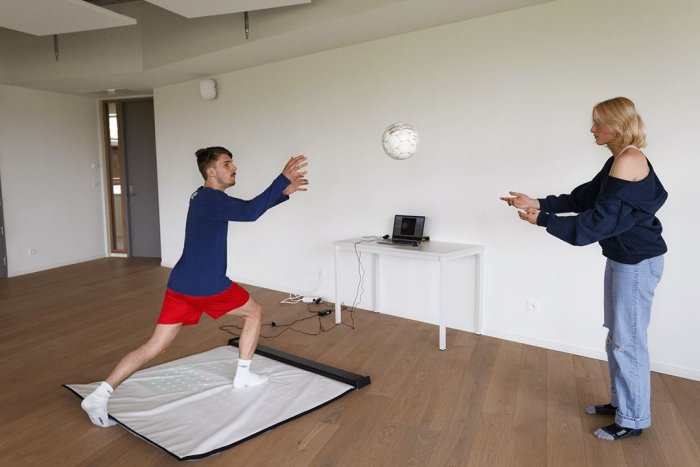
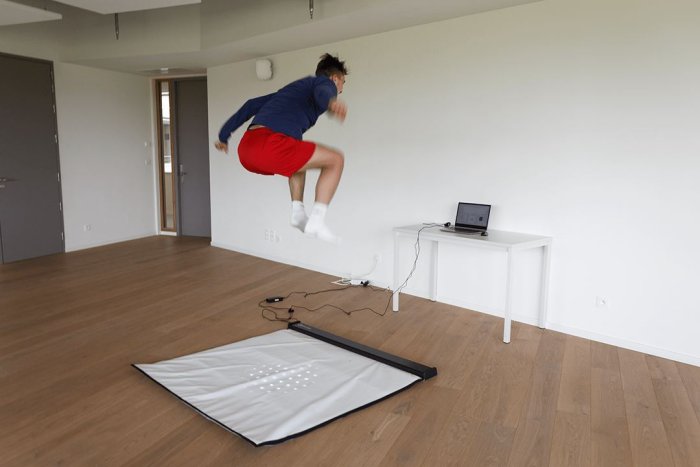
- Strengthening and stimulating the co-contraction around the knee joint.
- Dynamic and explosive exercises (`Return-to-Sport`)
- Increase jumping power and confidence in affected knee
To strengthen the knee, resistance exercises of flexors and extensors are usually used in this phase. For example, drop passes and deep lunges can be performed in combination with elastic bands and foam cushions. In addition, Tom`s jumping skills are also monitored and trained. Squats and vertical hops are currently being performed carefully. Much attention is paid to the necessary stability of the knee joint.
Whack-A-Light
Drop passes are practised more functionally through this game. Matti randomises the targets within the space indicated by the therapist. In Tom`s case, the targets are offered at the front of the knee. As can be seen in the photo, elastic bands can simply be used to make the exercise more challenging. In addition, the supporting leg can also be placed progressively backwards in order to increase the number of passes over time. By adjusting the settings of this game, both speed and control can be worked on. By reducing the reaction time of the goals, Tom must move the foot quickly and in a targeted manner. By increasing the pressure time of the targets, work can be done on controlled weight transfer and optimal attention can be paid to knee stability.
Obstacle Runner
This game provides a unique environment in which different tasks can be practised. To make the ball roll, Tom has to kick it on the spot. She can set the pace by moving faster or slower. Obstacles are avoided by smooth lateral movements on Matti while maintaining continuous steps. By adding low obstacles (via the settings) the player is expected to integrate vertical jumps throughout the exercise. All of these tasks combine to create a functional exercise that can help Tom get back to his volleyball training sooner.
Jump Analysis
With the Jump Analysis, the therapist can further investigate and monitor Tom`s jumping form. In this way, we get the jump power back to its original level and ready for competition.