


BIO INX products
3D Print Technology - Inks for Volumetric Printing
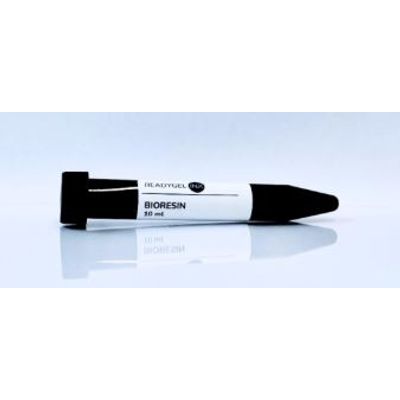
READYGEL INX - Model X100 - Gel-MA Bioresin for Volumetric Bioprinting
READYGEL INX is a Gel-MA bioresin derived from natural collagen, incorporating RGD motifs within its structure to effectively mimic the extracellular matrix. It allows cellular remodeling and is designed for use in volumetric bioprinting, facilitating rapid creation of complex structures at centimeter scale within 10 to 20 seconds regardless of dimensions. Upon photo-crosslinking, the bioresin achieves a stable physiological form, creating a network that, while non-soluble, remains biodegradable. This product is crucial for developing intricate biological structures, providing an innovative solution for tissue engineering and other bioprinting applications.
3D Print Technology - Inks for Deposition-based 3D Printing
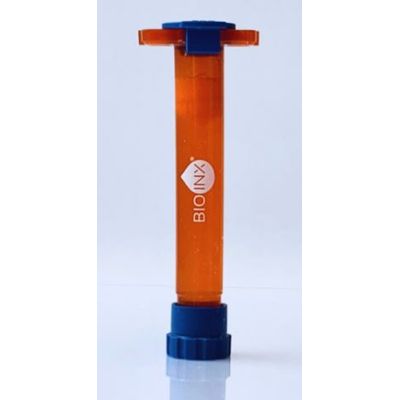
EASYGEL INX - Gelatin-Based 3D Printing Bio-Ink
EASYGEL INX is an advanced bioprinting solution that leverages gelatin-based, shear thinning properties to enhance 3D printing processes in biological applications. This ink mimics the extracellular matrix, supporting high cell viability and offering enhanced efficiency in creating complex structures. By incorporating photo-crosslinkable functional groups, EASYGEL INX improves print fidelity and reliability. Designed for printing feasibility at physiological conditions, specifically at 37 °C, it requires a heatable printhead and nozzle insulator. Derived from natural collagen, it is offered as a clear hydrogel in a pre-filled 3 ml cartridge, facilitating straightforward application and integration in various research and biomedical setups. Its compatibility with advanced bioprinting technologies underscores its utility in tissue engineering and regenerative medicine, making it suitable for a wide range of scientific pursuits.3D Print Technology - Inks for Digital Light Processing & Stereolithography
BIORES INX - Model DLP-101-010 - Resin for DLP Technology
BIORES INX is a specialized resin engineered for digital light projection (DLP) technology applications. It is formulated from gelatin methacrylamide, or Gel-MA, a derivative of natural collagen known for its widespread use as a benchmark material in tissue engineering and biofabrication. This resin remains liquid at room temperature, which streamlines the 3D printing process by removing the need for pre-printing heating. Upon printing, it forms a robust, biocompatible, and biodegradable hydrogel network, making it ideal for a variety of biomedical applications. Its properties are particularly valuable for creating complex structures tailored to biomedical needs, combining ease of use with superior biological performance.