


CELLINK products
Biomaterials - Bioinks - Ready to use Bioinks
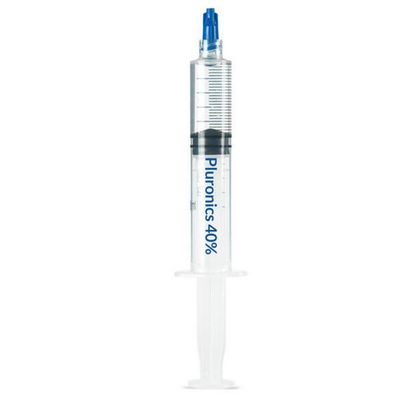
CELLINK - 40% - Support Bioinks
Pluronics 40% is a ready-to-print sacrificial and support ink that exhibits excellent printability. This ink has been optimized for the fabrication of vascularized tissues, channels in microfluidic devices, and supporting scaffolds for complicated tissue constructs. The ink is easy to remove ones printed by washing with cold PBS or similar. Pluronics 40% is ideal to be used in conjugation with VasKit Perfusion Device to generate perfusable channels.
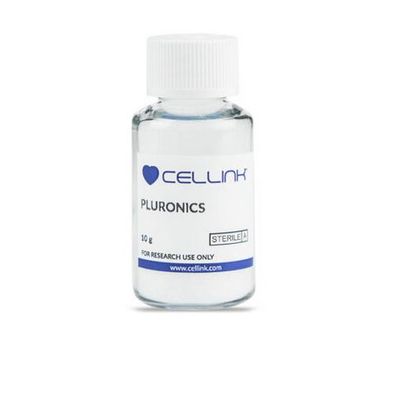
CELLINK - Pluronics Powder
The Pluronics Powder can be dissolved in water to create hydrogels with excellent printability. The prepared hydrogels can be used for 3D printing of vascularized tissues, channels in microfluidic devices, and supporting scaffolds for complicated tissue constructs. Pluronics gels are easy to remove ones printed by washing with cold PBS.
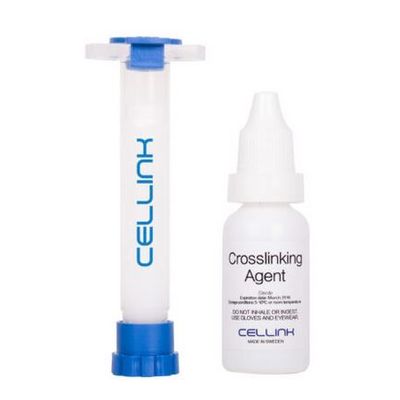
CELLINK - Crosslinking Agent - Bioink
CELLINK Bioink is the first universal bioink designed to print human tissue models with any commercially available or in-house developed 3D-bioprinting system. The nanosized fibrils make the bioink semi-translucent and is thus compatible with many advanced imaging techniques. Batch-to-batch consistent and temperature-independent shear thinning properties of the bioink ensure the best 3D bioprinting experience, and morphological similarity of cellulose nanofibrils to collagen provides mammalian cells with a milieu that resembles their fibrillar natural matrix. Altogether, this enables you to bioprint complex, cell-laden tissue constructs, such as cartilage, bone grafts, liver cancer models. After bioprinting, CELLINK Bioink crosslinks easily with the included ionic crosslinking agent.
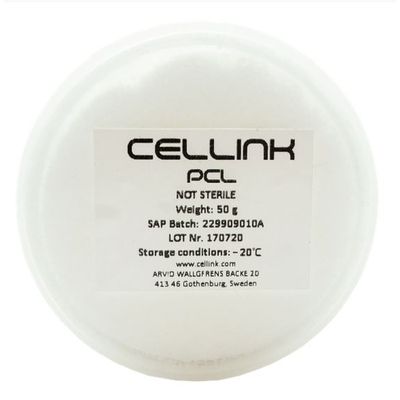
CELLINK - Thermoplastic Inks
CELLINK® PCL is a high-molecular weight (Mn 50,000) thermoplastic linear polyester derived from caprolactone monomer. This biodegradable polyester has a melting point of 60° C. PCL provides a reinforcing structure to load-bearing tissue constructs, including bone grafts and osteochondral plugs developed for in vitro and in vivo studies. It can also provide a temporary scaffold for overhanging structures.