

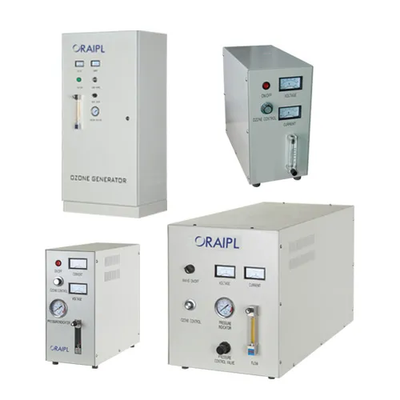
Oraipl - 1 Gram/Hour - 60 Grams/Hour Small Ozone Generators
ORAIPL is your trusted Small Ozone Generator manufacturer from India, manufacturing Ozone Generators of capacity ranging from 1 g/h to 60 g/h of Ozone output. Since 25 years, we have been the global leader in manufacturing Ozone Generators, and complete Ozonation systems for water treatment, effluent treatment, cooling towers, chemical industry, air and gas purification and other ozone applications.
We can supply and install Small Ozone Generators all over the world, including USA, Canada, Europe, Middle East, South East Asia, Vietnam, Brazil, Russia, Australia and Africa. We have a strong global team of expert ozone professionals, and we assure quick turnaround times, and trusted technical support.
If you are looking for Ozone Generators of higher capacities, please take a look at our range of Medium Ozone Generators and Large Ozone Generators.
Technology
Our Small Ozone Generators are based on the silent Corona Discharge technology, where air is passed though a high electrical charge. This splits the Oxygen (O2) atoms in the air, and the single split Oxygen atoms (O), bond with the other O2 molecules in the air and form Ozone (O3). All our Ozone Generators can work with either dry air feed or Oxygen feed for higher efficiency.
We can configure our Small Ozone Generators to work with both Air Source and Oxygen Source. We can manufacture small ozone generators as per your application and requirements.
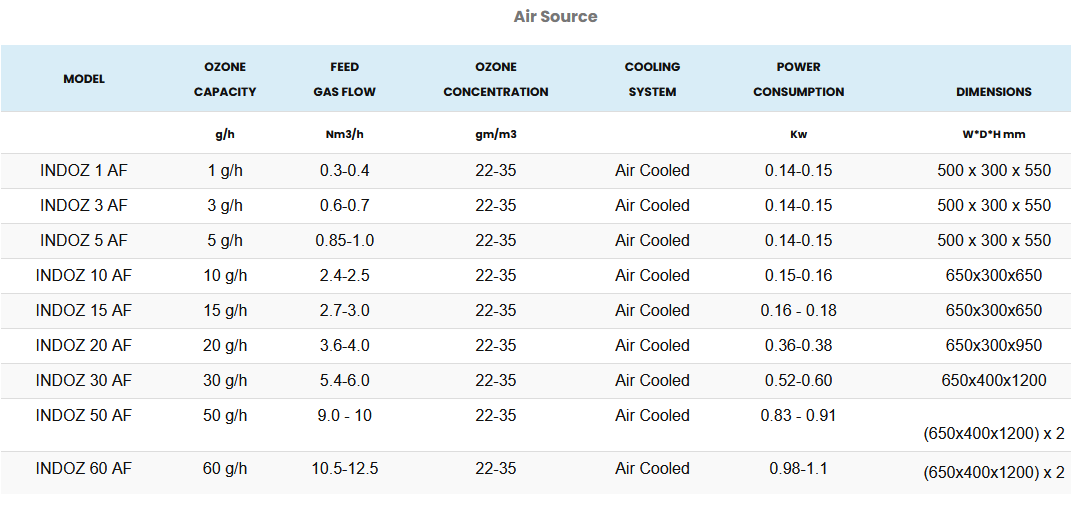
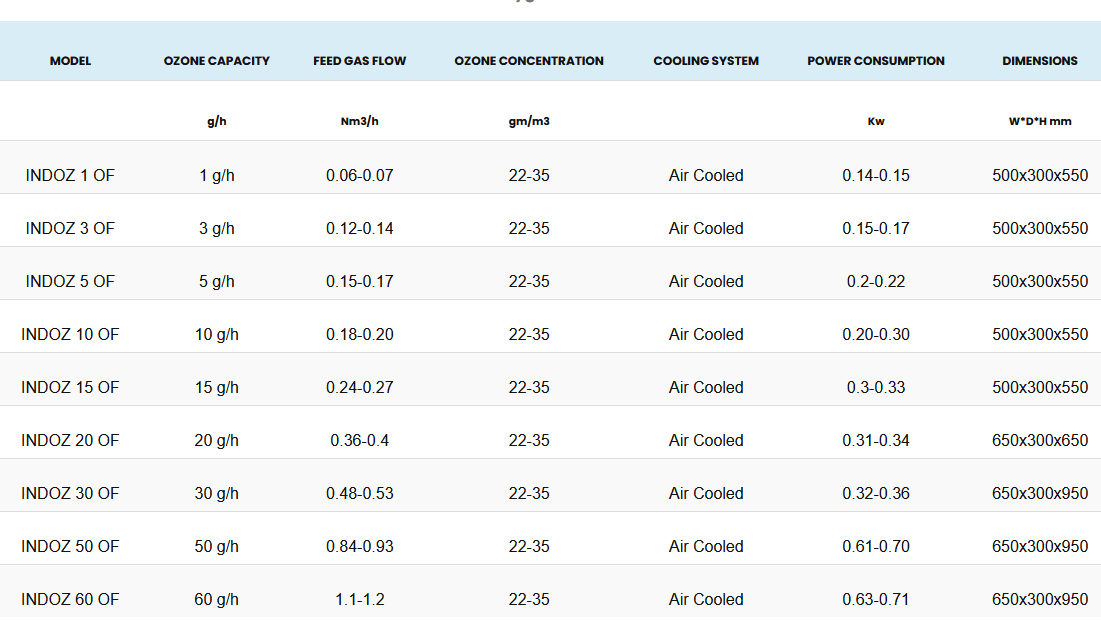
ORAIPL manufactures a wide range of Small Ozone Generators that can be used for water treatment and air treatment in:
- Swimming Pools
- Pharmaceuticals
- Indoor & Outdoor Exhaust Air Purification
- Restaurant & Hotel Kitchens
- Medical Supplies
- Food disinfection
- Fruits & Vegetables disinfection
- Spice industry,
- Any other applications where the Ozone requirement is between 1 g/h to 60 g/h.
Ozone from our Small Ozone Generators can be used directly, or mixed with water or air. Ozone is a very powerful disinfectant and it can be used to disinfect water and air. Ozone or Ozonized water can be used in many disinfection applications, like disinfecting hospital equipment, pharmaceutical equipment, cold storage, food processing lines, work clothes, and apparatus.
Ozone is also a very powerful oxidizing agent. Ozone can break down the carbon chain of organics, like alkyne and alkene, and make them form new chemical compounds after oxidation. Because of this property, our small Ozone generators can be used in the Spice industry, pharmaceutical industry, modification of carbon black, and for chemical intermediates synthesis.
Because of its strong oxidation properties, Ozone reacts with pollutants and breaks them down into less complex and less harmful molecules through oxidation and also kills bacteria, virus, molds, algae, etc. Ozone also acts as an aid to coagulation, and can be used for flocculation of particulate matter impurities in water.
If you need a small Ozonation system for your application, ORAIPL is your trusted Small Ozone Generator Manufacturer from India.
Why ozone?
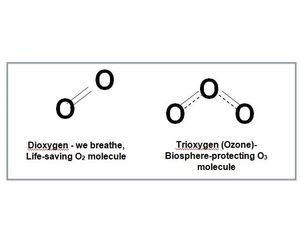
There are multiple benefits of Ozone over any other disinfectant and oxidant. Oxygen is a chemical element with the symbol ‘O’ and atomic number 8. It has two allotropes, dioxygen (O2 molecule) and trioxygen (Ozone, O3, see Box 1)). Dioxygen, which is the third most abundant gas in Earth’s atmosphere, has several chemical & physiological functions. It is a strong oxidant, can convert many other elements into corresponding oxides, and sustains different life forms including humans by binding to Fe in haemoglobin and getting transported to various body parts for cellular respiration and energy generation.
On the other hand, its triatomic cousin, Ozone, is highly reactive, more powerful oxidant and disinfectant. It (O3) is constantly in search of partner molecules to whom it can transfer one of the three oxygen atoms and revert to stabler O2. It strongly absorbs ultraviolet UV-B radiation, and the high-altitude ozone layer helps protect the biosphere from adverse impacts of exposure to ultraviolet radiation. Ozone in Earth’s atmosphere is regarded as a pollutant, one of the six pollutants monitored in ambient air quality.
Putting a pollutant to work
Putting ozone, a common air pollutant, to destroy water borne pathogens, viruses (disinfection) and other chemical pollutants (oxidation) is very exciting. This field has emerged as an attractive research area and opened significant industrial & business opportunities in several sectors.
Disinfection of water using ozone is advantageous compared to more traditional methods, such as chlorine or UV disinfection.
- Firstly, ozone is more effective at killing/deactivating viruses and bacteria than any other disinfection treatment. It is 3000 times more powerful disinfectant than chlorine.
- It disinfects, oxidizes, deodorizes, and decolorizes simultaneously. Not many disinfectants combine these attributes for simultaneous treatment.
- Ozone requires lesser contact time, thus reducing the overall treatment residence time. Its half life in water is 15 min at pH 7 and 25 °C in contrast to 3 days in air at 20 °C.
- Ozone leaves no chemical residues/solids post-reaction as it decomposes into O2
- Ozone can be produced on site. Requires no shipping or handling and associated complications like safety and environmental issues are eliminated.
ORAIPL is a leading manufacturer of Ozone Generators, trusted by industries and municipal bodies all over the world, since 25 years.
CLICK HERE to see our wide range of Ozone Generators and Ozonation Systems for every application.
Other benefits of ozone over other disinfectants/oxidants are as in the following:
Raw material
Ozone is obtained from abundant and cheap raw material (Air)
Half-life & Water Solubility
Much shorter half-life (15 min) in water compared to chlorine (upto 5 hours). There is greater risk of occupational exposure if chlorine is used. Use of ozone doesn’t cause such undesirable exposure
Powerful disinfectant
- Ozone is a powerful sterilizer and microbial remover, requires 6-10 times lower doses compared to chlorine to achieve 4-log viral inactivation.
- Giardia cysts (protozoa) is found in human stools that often contaminate water bodies. Its deactivation is deemed most difficult and passes unaffected through most disinfection technologies. However, using O3, a 3-log deactivation is attained at a dose 75 -100 times lower than that of Cl2.
- Unlike Cl2, maintaining a residual concentration of ozone in water is very difficult due to its shorter half-life. For this reason, though O3 is a stronger disinfectant, it is often not deemed as a suitable disinfectant!
- Ozone doesn’t generate trihalomethane (THM). THMs which form during Cl2-based disinfection are toxic and cancer causing compounds.
- No disinfection by-products (DBP) generation (except for bromates if bromide is present in water). In fact, O3 can remove precursors for formation of disinfection by-products.
Bio-oxidation enhancer
- Oxidizes recalcitrant organics and improves biodegradability of wastewater (increases BOD/COD ratio).
- Improves DO level in wastewater.
- Helps in healthy growth of bacteria (MLSS).
- Increases the settling efficiency of MLSS.
- Generates lesser amount/volume of biological sludge.
Food Preserver
With its unique disinfection attributes, ozone protects food grains from infestation and moulds and fungi.
No Safety Hazard
It quickly decomposes into O2, hence no serious problem in case of over dosage.
CAPEX/O&M
- Somewhat higher initial costs.
- But lower O&M costs and environmental & health benefits accrued can very well compensate higher CAPEX.
Environmental Impact
- 13 kg CO2e/kg O3 produced @ 22 kWh/kg O3 per hr @ 0.233 kg CO2e per kWh energy consumed (includes power consumption by air compressor, refrigeration/chiller, plasma/corona generation, ozone destruction) versus 29.82 kg CO2e/kg @128 kWh/kg Cl2 @0.233 kg CO2e per kWh energy consumed (includes power consumed for brine purification, utilities, Cl2 compression/liquefaction). Thus, the GHG emissions are 5-6 times less during O3 production compared to Cl2 production on large scale.
- Unlike Cl2 which is banned for some applications due to reverse environmental impact, ozone is free from such impact.
Based on the above benefits of ozone, extensive applications of ozone in wastewater treatment, potable water disinfection, air cleaning, and food preservation have been developed by ORAIPL.
These are some of the main benefits of Ozone for treating and polishing water:
- Aid to Coagulation
- Algae Removal
- Color Removal
- Disinfection
- Iron and Manganese Removal
- Reduction of Non-Metal species
- Effect of Pre-Ozonization
- Effect on Chlorinated DBP (Disinfection By-Products)
- Effect on Organic Compounds
- Effect on Taste and Odor
As you can see Ozone has several advantages over any other other option in disinfecting, polishing and improving the quality of treated water. Ozone is being used to treat Municipal Drinking Water, Industrial Effluents, Grey Water, Black Water, Sewage Treatment, Lake Remediation, Soil Remediation, Air Purification, and many more applications.
With the advancements in Ozone Generator manufacturing technology, it is now much easier to produce and use Ozone on-site for water, gas and soil treatment.
ORAIPL is the global leader in the manufacture of Ozone generators, right from small 5 g/h capacity, to very large 80 kg/h capacity.
Ozone for Disinfection
More and more municipal corporations around the world are now switching over to using Ozone for Disinfection in their water treatment plants. Ozone is a very powerful disinfectant, and is much more effective than Chlorine in killing virus and bacteria in water. Ozone is also a very powerful oxidizing agent, and can reduce heavy metals like iron, sulphur and magnesium in water, by oxidizing them and converting them into insoluble particles which can be removed by coagulation.
According to the US EPA, disinfection of water is the main mechanism for eliminating harmful pathogens in water, and reducing the incidence of water borne diseases like amoebic dysentery, Cholera, Typhoid, Leptospirosis, Hepatitis, Gastroenteritis and Diarrhea. Over 3000 municipalities worldwide now use Ozone Generators to generate Ozone in water treatment plants, for disinfection of both drinking water and wastewater. Ozone can deactivate and kill all harmful pathogens, virus and bacteria in water, thus making it safe for consumption. Ozonation of water is much more effective than Chlorinination, which can leave behind harmful and carcinogenic by-products in the water. Ozone on the other hand is converted into Oxygen (O2) after application, and leaves behind no harmful by-product.
Ozone is also very effective in oxidizing several common pesticides present in ground water. Pesticides like Diazinon, Dimethoate, Parathion-Methyl, Diuron, Linuron, MCPA, MCPP, Methabenzthiazuron, Metobromuron, etc are easily degraded anywhere from 80% to 99% by Ozone. For highly resistant pesticides, a higher dose of Ozone can be
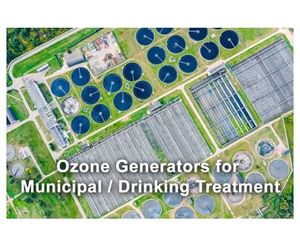
ORAIPL can design and supply Ozone Generators for your water treatment plant, as per your requirements. We are the market leaders in Ozone Generator technology, and have successfully installed Ozone Generators for many municipalities and commercial water treatment applications around the world. We can also help you achieve higher efficiency and purity levels for your water treatment plant, using our expertise and experience of over 25 years in Ozone Water Treatment technology.
Get in touch with our experts if you would like to know more abut how you can effectively use Ozone for Disinfection in your water treatment application.
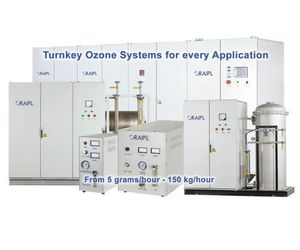
Ozone for Algae Removal
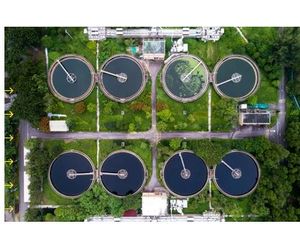
Using Ozone for Algae Removal in water treatment is one of the most effective way to control organic contamination of water. ORAIPL can design and supply any capacity of Ozone Generators to produce Ozone on-site, for water treatment plants.
Algae, or more accurately plankton, create several problems including:
- Algal blooms
- Poor coagulation and flocculation
- Poor settling characteristics
- Various bad odors and tastes
- Some species of algae may by toxic
- Living or dead algae can be responsible for bacterial growth
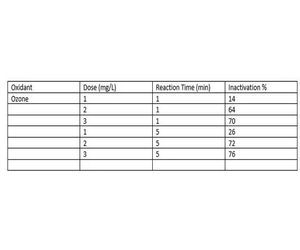
Ozone is very effective at killing microorganisms, including algae, because of its strong oxidizing capabilities, targeting the cell membrane. Ozone is also capable of inactivating certain zooplankton, including certain mobile organisms like Notholca caudata. In order to remove such organisms by either flocculation or filtration, they must first be inactivated. The table below illustrates the advantage of inactivation as a preliminary step in the removal of certain types of plankton.
Inactivation of Notholca caudata by Oxidation
You can see in the results in the table, that Ozone is able to inactivate algae up to 76% in just 5 minutes. In comparison, other commonly used oxidants like Potassium Permanganate and Hydrogen Peroxide take up to 60 minutes or more to achieve the same results.
So if you are struggling to control algae and plankton in your Water Treatment plant, Ozone is the best aid for algae removal efficiently. ORAIPL can design and supply Ozone Generators, customized to your requirements, anywhere in the world. We are the leaders in Ozone Water Treatment technology, with an experience of over 25 years in the industry. We are trusted by government institutions and large commercial organizations around the world.
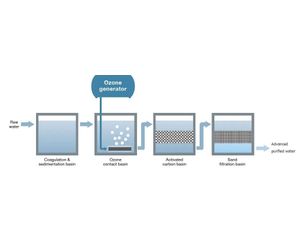
Ozone as an Aid to Coagulation
Ozone is used as an excellent aid to coagulation, for particulate removal in the water treatment process. Ozone does not leave behind any by-products, and is a far superior option than using chemicals and salts for coagulation. ORAIPL can design and supply Ozone Generators of any capacity for particulate coagulation in any water treatment application.
In a water treatment plant, particulate removal begins with coagulation, which involves the addition of a chemical to neutralize the charges on particles and facilitate their agglomeration during the slow mixing provided in the flocculation step. Coagulation also helps prepare the particles for filtration. Data shows that pre-ozonation of the raw water is much more effective than pre-chlorination to decrease effluent turbidity.
Many of the particles that must be removed in water treatment are very small and are referred to as colloids. These particles carry an electric charge on their surface: because of their small size this surface charge has an important influence on their behavior. Because of the particles carry the same charge (usually negative), they tend to repel one another. The purpose of coagulation is to neutralize these charges so that the particles can combine to form large agglomerations if they contact one another. Larger particles settle much faster, and in addition neutralized particles are much more susceptible to filtration. Coagulation is always followed by a period of low-energy mixing called flocculation, which promotes particle-particle contact and the growth of particle aggregates known as flocs. If sedimentation is used; flocculation will occur in a separate chamber, if filtration is used; flocculation may take place in the liquid above the filter, or even in the pores of the filter.
The most common chemical coagulants include aluminum salts (e.g. alum, and polyaluminum chloride), iron salts, and organic polymers.
Ozone has proved to be an excellent aid to coagulation. Particulate removal can be accomplished through the coagulating effects of ozonation. This phenomenon may take the form of a wide range of secondary effects, such as a shift in particle size distribution towards larger sizes; the formation of colloidal particles from dissolved organic matter; the improved removal of TOC (Total Organic Carbon) or turbidity during subsequent settling, flotation, or filtration; a decrease in coagulant dose necessary for achieving desired effluent turbidity or TOC; an increase in floc settling velocities; and extended filter run length due to slower head loss buildup or delayed breakthrough. These are called secondary effects because they do not occur instantly at the moment of ozone reaction, but begin to manifest themselves. What this all means is that the clarity of the water will improve and material will settle out of suspension. This benefit of ozonation may be achieved at a relatively low ozone dose of 0.5 – 1.5 mg/L.
Mechanisms for the Coagulating Effects of Ozone
- Loss of Organic Coating
Ozone strips the organic coating from clay particles returning them to their destabilized state. These particles would be relatively free of the high negative surface charges and thick adsorbed organic layers that serve as a barrier to particle agglomeration. Therefore the particles would flocculate much more easily. It should be noted that this mechanism cannot account for a significant TOC removal since only a minor fraction of the organic content in most natural waters is associated with clay particles. - Increased Aluminum Complexation
Carboxylic and phenolic functional groups in natural organic matter (NOM) form complexes with aluminum oxide surfaces, forming organic matter-aluminum surface associations. Removal of DOC by activated alumina is increased with increasing numbers of acidic groups up to perhaps an optimum of three. Ozonation can therefore increase the degree of adsorption of NOM to activated alumina and to aluminum hydroxide by increasing the concentration of oxygenated functional groups (especially carboxylic acids). - Increased Calcium Complexation
An increase in the number of carboxylic acid groups may also lead to an increase in the degree of calcium complexation, resulting in direct precipitation of the organic matter. An increase in the complexation of Calcium may also lead to improved adsorption of organic to alum floc, as well as to other precipitating metal oxide surfaces such as MnO2. - Organic Polymerization
Ozone induced oxidative coupling may also play a role in the coagulating effects of ozone. Oxidative coupling involves the joining of small soluble molecules via C-C and C-O bonds to give large fulvic acid type molecules and eventually the larger and relatively insoluble humic acid type molecule. Oxidative coupling is thought to be responsible for the presence of nearly all colored substances. These reactions increase the molecular size improving the removability of organic material by coagulation
Coagulation/Filtration
In addition to the ability of ozone to immediately oxidize some organohalide precursors (TOX), it may also improve the removal of organic precursors in subsequent coagulation. Preozonation can improve the coagulation of THM precursors through both subsequent coagulation and filtration. ORAIPL can design and manufacture any capacity Ozone Generators for water treatment plants, and help you use Ozone as an effective aid to coagulation.
Ozone Treatment for Taste and Odor Control of Water
Ozone water treatment is the best solution for eliminating bad taste and odor from water. The consumer acceptance of drinking water depends highly on its taste and odor. Everyone wants their water to taste, smell and look good. If the water has a bad taste or bad odor, it will be rejected by the consumer. The Washington State Department of Health does not recommend that you drink water that tastes, smells and looks objectionable.
Bad odor and bad taste in water can originate because of both organic and inorganic compounds in the water. These can also be a result of chlorination and other water treatment processes. Ozone treatment can eliminate all bad taste and odor from water, making it much more palatable.
ORAIPL can design, manufacture and supply Ozone Generators for Taste and Odor removal for your drinking water treatment plant. We are the industry trusted experts in Ozone Water Treatment technology. We have a rich experience of over 25 years in this field. We can supply Ozone Generators from capacities of 1 g/h to 150 kg/h depending on your requirements, anywhere in the world.
Odor and bad taste forming compounds can originate in water from organic sources like decomposing plant matter or from the activity of living organisms in the water. Geosim and Methylisoborneal (MIB) also cause seasonal musty or earthy smell and taste in water. Bad odor and taste in water can also be a result of inorganic compounds like Iron and Hydrogen Sulfides. Industrial pollution, and by-products formed during the water treatment process itself, can also cause unpleasant taste and odor in water.
Advantage Ozone
Using Ozone in drinking water treatment, is very effective in removing all such unpleasant odor and taste from water. When used in combination with other methods like Aeration, Sand Filtration and Granular Active Carbon, Ozone can virtually eliminate all bad odor and taste from water.
If you are looking for a solution to eliminate bad odor and taste in your water treatment plant, get in touch with our experts right now. We can suggest the best Ozone Generator setup for your water treatment plant, depending on your application and needs.
Ozone can be used both at the pre-filter stage, and post filter stage to improve the quality of water. Ozone Generator technology is now much more cost effective than before, and is superior to all other legacy chemical and salts based technologies to purify water.
