


- Home
- Companies
- IMPACT International GmbH
- Products
- Autologous Cell Therapies
Autologous Cell Therapies
Autologous cell therapies make use of the natural endogenous mechanisms for the regeneration and healing of injured tissue. The body’s response to an injury is a complex healing cascade in order to heal the wound as quickly as possible. To understand how this regeneration process works, let us take a look into the cellular level.
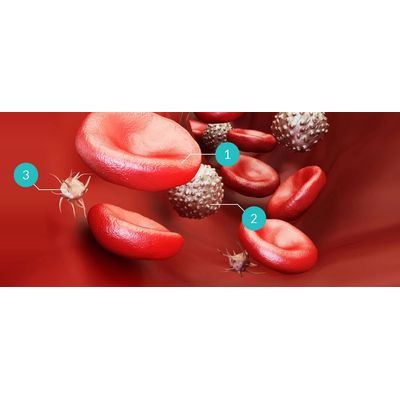
Histologically, three types of cells can be discerned in the blood:
- Erythrocytes responsible for the transportation of oxygen and carbon dioxide,
- leukocytes which divide up into different types and regulate the immune defense,
- as well as thrombocytes, also referred to as blood platelets.
Platelets are responsible for hemostasis, and mediate the first phases of wound healing. In this phase, platelets aggregate and form the blood clot. In addition, growth factors are released by degranulation of thrombocytes.
The release of cellular growth factors supports healing by
- Attracting undifferentiated cells to the site of the injury (chemoattraction and migration) and by stimulating mitosis of undifferentiated cells (proliferation)
- Suppressing cytokine release, thus reducing anti-inflamma- tory reactions
- Attracting macrophages for the improvement of tissue healing and regeneration
- Supporting capillary growth and accelerating epithelization
Leukocytes form several cytokines, referred to as interleukins. They mediate between leukocytes and play an important role in immune defense.
Autologous cell therapies use exactly these processes of the natural healing cascade – the body´s complex response to an injury. They contain growth factors, antiinflammatory cytokines or stem cells in concentrated form, for example. After injection to the defect, they assist the body in a natural way to heal the injured tissue.
PRP principles of preparation
The starting point is always the patient’s venous whole blood. Centrifugation of the blood sample separates the cellular fractions of the blood. Depending on the therapeutic goal, different cellular components are separated; moreover, different concentrations of these components are possible.1
PRPs can be activated before application by adding activating substances (e.g. calcium gluconate or autologous thrombin).2