


- Home
- Companies
- JASCO Applied Sciences (Canada) Ltd.
- Products
- Model AMAR G3 - Autonomous Multichannel ...
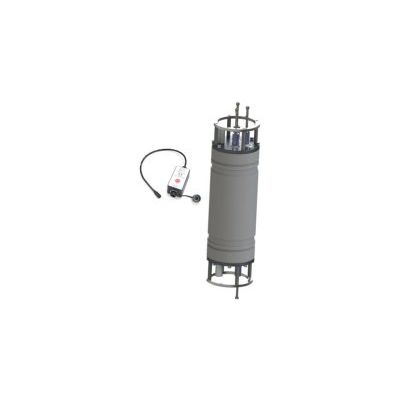
Model AMAR G3 -Autonomous Multichannel Acoustic Recorder
An underwater acoustic and oceanographic data recorder purpose-built for ultra-low power usage and superior data quality: Standard (250 m) and Deep (2500 m) models. Efficient power use for long deployments. Up to 8 hydrophones sampled at 24-bit resolution at rates up to 128 ksps. A high-speed, 16-bit acoustic channel at up to 687.5 ksps. Customizable to include oceanographic sensors (oxygen, salinity, acidity, temperature, etc.). Extremely low noise floor. Up to 1792 GB solid-state storage memory. Highly configurable duty-cycling and recording options. Autonomous recording or real-time data streaming via cable or telemetry system.
Superior data quality
The breakthrough design of the AMAR electronics provides an extremely low noise floor that lets you measure quiet or distant events. The 24-bit data sampling gives you accurate measurements over a wider range of sound levels than traditional 16-bit systems.
Efficient by design for extended deployments
The AMAR is optimized to use as little power as possible:
- Solid-state memory custom designed to consume very little power
- Leading-edge hardware and software purpose-built for intelligent, ultra-low power usage achieved by turning off unused components
- Large memory capacity up to 1792 GB for extended deployments, even at high sample rates
- Extended-life battery options
- Highly configurable duty-cycling (power saving) options
With fewer batteries, the AMAR G3 is smaller and lighter than other recorders. Save time and money with longer deployments and fewer service trips.
Survives extreme conditions
The AMAR is built to perform in the harshest conditions. The rugged, industrial design has been field tested in extreme environments, from the heat of northern Australia to the sub-freezing oceans of the Arctic. The custom-designed solid-state storage memory is more mechanically resilient than traditional hard-disk drives. You can download your data without opening the pressure housing, so the AMAR electronics are protected from the environment.
The flexible solution: versatile and configurable
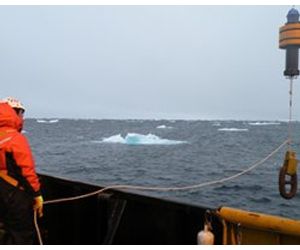
Advanced configuration options meet your performance demands. Whether studying effects of vessel noise on low frequency call rates of baleen whales off Alaska, or high-frequency clicks of dolphins in the Great Barrier Reef:
- Eight 24-bit acoustic channels at up to 128 ksps
- The high-speed 16-bit acoustic channel offers ground-breaking sample rates up to 687.5 ksps
- Multiple digital and analog interfaces to support oceanographic data sensors or integrate into your existing systems
- Choose between Standard (250 m) and Deep (2500 m) models
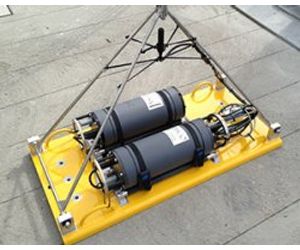
JASCO works closely with hydrophone manufacturers to develop the right system for your unique needs. The AMAR is compact and lightweight for cost-effective, fast, easy deployments by hand. Buy or lease custom-designed moorings or use our specialized mounting brackets to secure the AMAR to your own gear.
Intuitive user interface
The AMAR Comms Box instantly displays the AMAR’s status. And it connects the AMAR to your computer with a standard Ethernet cable to configure the AMAR and download data.
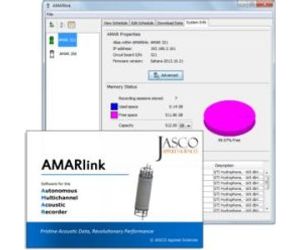
The AMARlink software is designed for usability: easy to learn and easy to use. Set up multiple sampling rates, duty cycles, and recording schedules with ease. Save your recording schedules for quick and easy reuse. Download all or some of your data at the click of a button.
Environmental
Max. depth: Standard (250 m)
Deep (2500 m)
Operating temperature: −5 to 50 °C
Storage temperature: −18 to 55 °C
Shock tested: 3 m drop into water
1 m drop onto concrete
Vibration tested: Transport by air, truck, or vessel
Physical
Dimensions: Ø 16.5 cm D × 57.2 cm L
Material: PVC, anodized aluminum, 316 stainless steel
Weight in air: 10 kg
Weight in seawater: 1 kg
Hydrophones and Arrays
Various customizable options.
Sensitivities and frequencies tailored to your needs.
Example sensitivities:
−164 dB re 1 V/μPa @ 1 kHz
−210 dB re 1 V/μPa @ 1 kHz
Example frequencies:
1 Hz to 50 kHz
5 Hz to 100 kHz
20 Hz to150 kHz
Manufacturers: Various, based on your needs
Acoustic sensors:
Omnidirectional hydrophones
Directional hydrophones
Vector sensors
Small spatial arrays
Small linear arrays
Power
Power: 7–16 Vdc
AC power adapter: 110–240 V 50–60 Hz 0.5 A
Internal battery pack: 9 alkaline D-cells
Optional external battery packs: 48, 96, and 144 alkaline D-cells
Memory & recording
Solid-state flash memory: 256–1792 GB
Recording lifetime: Over 1 year depending on configuration
Acoustic data format: WAV
Non-acoustic data format: CSV
Eight 24-bit acoustic channels
Two banks of 4 channels: Each bank has selectable sample rate
Sample rates: 2–128 ksps
Spectral noise floor: Better than −150 dB re FS at 128 ksps
Gain settings: 0–42 dB
High speed, 16-bit acoustic channel
Sample rates: 125–687.5 ksps
Dynamic range: 14.5 effective bits
Voltage: 0–4.5 V peak-to-peak
Ten oceanographic sensor channels
Sensors available: Oxygen, salinity, acidity/pH, temperature, depth, turbidity, orientation (roll-pitch-yaw), others upon request
Eight analog channels:
Sample rate: 1 Hz
Dynamic range: 10.5 bits
Voltage: −10 to +10 V
Two digital serial channels: RS-232 and RS-485