


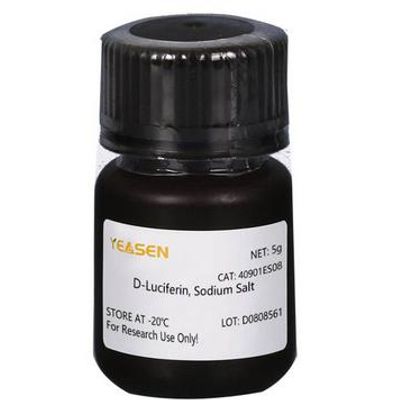
Yeasen - Model 40901ES -D-Luciferin, Sodium Salt
D-luciferin is a common substrate for Luciferase and is widely used throughout biotechnology, especially in vivo imaging technology. The mechanism of action is that luciferin (the substrate) is oxidized to emit light in response to ATP and luciferase (see figure below). It`s produced when there`s too much luciferin The light quantum number was positively correlated with the concentration of luciferase. Plasmids carrying luciferase encoding gene (Luc) were transfected into cells and introduced into study animals such as rats and mice In vivo, fluorescein is then injected and changes in light intensity are detected using bioluminescence imaging (BLI) to monitor disease progression or drug efficacy in real time and so on. ATP`s influence on the reaction system can also be used to indicate energy or vital signs according to changes in bioluminescence intensity.
D-luciferin is also commonly used in in vitro studies, including luciferase and ATP levels analysis; Reporter gene analysis; High-throughput sequencing and various contamination tests. There are currently three product forms: D-luciferin (free acid), D-luciferin salts (sodium and potassium salts). The main difference lies in solubility: the former is water-soluble and the solubility of buffer system is weak, except soluble in weak bases such as low concentration NaOH and KOH solutions, soluble in methanol and DMSO; The latter is easily soluble in water or buffer, easy to use, solvent non-toxic, especially suitable for in vivo experiments. As a solution, there is no substantial difference between the three products in the vast majority of applications.
- No radiation, almost harmless to living organisms.
- Bioluminescence, no excitation light source.
- So sensitive, you can detect it in a few hundred cells.
- Good penetration, 3-4cm tissue depth can still be detected.
- High signal-to-noise ratio, strong fluorescence signal and good anti-interference.
- In the tumorigenesis experiment in nude mice, the tumor growth was observed without invasion in real time, without tumor stripping measurement.
- To test the effect of the administration on tumor growth or metastasis, the fluorescein substrate can be completely eliminated within 3 hours, without interference to the drug experiment.
- The localization and distribution of foreign cells in animals were detected.
- The target gene or promoter of the target gene is fused to the luciferase gene to detect changes in gene expression during drug treatment or disease progression.
- Monitoring stem cell transplantation, survival and proliferation; Trace the distribution and migration of stem cells in vivo.
- English synonym: (S)-4,5-Dihydro-2-(6-hydroxy-2-benzothiazolyl)-4-thiazolecarboxylic acid sodium salt; D-Luciferin firefly, sodium salt monohydrate;
- CAS NO.: 103404-75-7
- Formula: NaC11H7N2O3S2·H2O
- Molecular weight: 320.32 g/mol
- Appearance: Light yellow powder
- Solubility: Solube in water(100 mg/mL)
- Purity (HPLC): ≥95%