

Navident - Dynamic Navigation for Dental Implantation
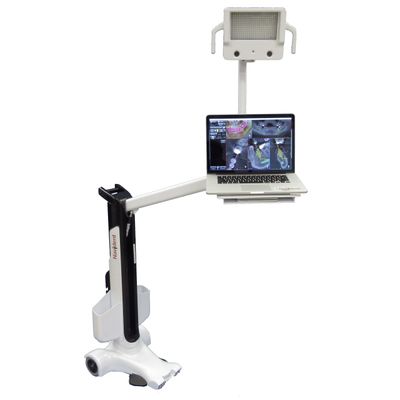
A breakthrough in computer-aided implantology, Navident offers dental surgeons an easy to use, accurate, highly portable and affordable way to plan the desired restoration and implant placement on a virtual patient, then execute the plan on the real patient’s jaw. The virtual patient’s jaw is created from the CT and, optionally, digital impression data, in seconds. The plan, including crowns and implants, is prepared in a few minutes and can be modified any time. During surgery, Navident shows the advance of the drill tip or implant in the patient’s jaw relative to surrounding structures and the implantation plan.
PLAN
Plan restorative-driven implant placement on a laptop
The restoration and implant placement plan is created using the CT image data, optionally with added intraoral scans or any other surface data (STL files). The plan can be modified at any time, even during surgery. Navident is compatible with any implant size and type available on the market.
TRACE
Register the CBCT scan to the patient by selecting 3-6 landmarks on the screen and tracing around those landmarks in the mouth with a tracer tool.
The registration process that formerly involved making a thermoplastic stent, taking an additional CBCT scan with a significant opportunity for irrecoverable user error, has become an efficient, user friendly and easily repeatable 2 minute process.
PLACE
Drill and place the implants under dynamic guidance
Following a brief drill or implant calibration, Navident dynamically presents the deviation between the actual/planned position and orientation of the drill/ implant, guiding the surgeon to accurately implement the plan.
View the CT data and change the plan at any time, even during surgery.
Guidance immediately available following planning – no need to wait weeks for guide to arrive.
More predictable – stent problems can be detected and corrected on the spot.
Accuracy check always available – large errors immediately observed and addressed.
User friendly and intuitive planning – no need to design the guide and sleeves.
Lower cost per procedure. No expensive kits or specific drills.
Better irrigation during drilling of open osteotomy site.
No need for longer drills which interfere or preclude usage in posterior implantation sites with minimal jaw opening.
Fully open – any implant, any drill system, any handpiece. No need to buy special kits.
Guides the implant itself, not just the drilling.
The EvaluNav application, included in Navident, enables evaluation of the deviations between the planned and the actual position of implants appearing in a post-operative (“post-op”) CT scan. Once the pre- and post-op scans are loaded and registered to each other, the exact position of each implant is detected in the post-op CT and compared to its planned position in the pre-op scan. The deviations at entry and apex and angle are automatically computed and presented both visually and numerically. Provided the implant itself was inserted under guidance, EvaluNav is able to further separate guidance deviation (system error) from drilling deviation (user error).