


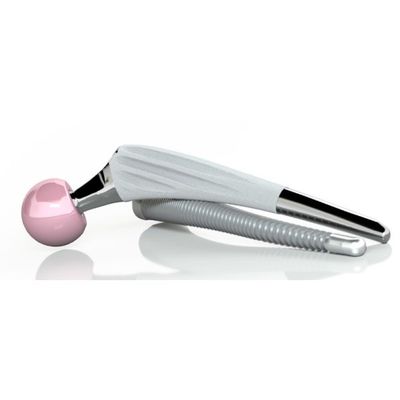
LINK - Model SP-CL -Hip Prosthesis System
The S curvature follows the natural anatomical shape of the femur. Rib profile for high primary stability and structural elasticity, Bone preserving, Minimally invasive implantation, LINK HX coating,
Developed for physiological force transmission
Metaphyseal fixation of the SP-CL is assisted by the HX coating (CaP). At the same time, the polished distal stem region protects against thigh pain. Medially the SP-CL rests along the length of the calcar (Shenton’s line) and is intended to promote a physiological distribution of forces.
Reduced stress shielding
The successful ribbed structure provides initial fixation in the compressed cancellous bone. This makes it possible to achieve a design elasticity in spite of the proven “fit and fill” principle in the proximal femur. Thus the ribs not only provide high primary stability, but in combination with the LINK Tilastan- S alloy, they also achieve double elasticity. This can lead to a reduction in “stress shielding”.
Bone preserving
Anatomically shaped stems necessitate anatomically shaped instruments. The compressors in the SP-CL System follow exactly the anatomical design of the stems and prepare the bone bed for the SP-CL stem according to the natural contours of the intramedullary canal in the proximal femur.
While the flat, lateral implant profile is designed to protect the greater trochanter during implantation, cancellous bone compressors help to preserve valuable bone substance during resection.
The compact, ergonomically designed instrument set permits effective, smooth intraoperative working.
Proven design
The LINK SP-CL Hip Prosthesis System, with its anatomical, cementless design and its different versions, is aimed at the treatment of a wide range of patients. In order to meet the heavy demands put on the implants in a special way, the femoral components consistently follow the principle of the anatomical stem shape4, which has been in successful use for decades.
The anatomical S-shape helps to reduce stress peaks, which are a familiar problem with three-point fixation of straight stems. At the same time, it gives the implant greater rotational stability.