


- Home
- Companies
- ImpulsTec GmbH
- Products
- ImpulsTec - Shock Wave or ...
ImpulsTec - Shock Wave or Electrohydraulic Fragmentation Technology
The shock wave or electrohydraulic fragmentation process is currently only used to a limited extent in Germany. It can be classified in the field of pulsed power technology, which represents a largely new technology in Germany. Previous applications at research institutes were mostly limited to the homogeneous fragmentation of old concrete. Commercial applications exist in the form of extracorporeal shock wave therapy (“lithotripsy”), sheet metal forming or sanding of sand castings in the casting industry. The material-selective electrohydraulic fragmentation process (EHF) from ImpulsTec GmbH offers a convincing solution for the material separation of complex material composites. The method uses mechanical shock waves, which are generated in a fluid medium, in order to bring about an energy coupling and thus a separation of the composites.
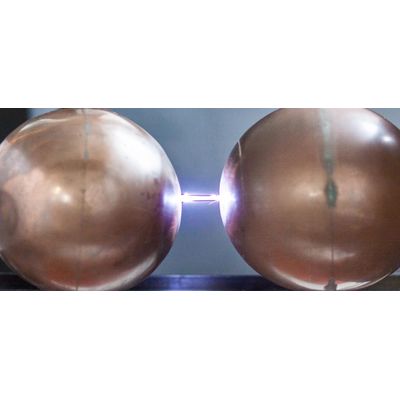
The shock waves are generated with the help of the electro-hydraulic effect, in which a short-term, intense arc is ignited in a liquid between two electrodes. To this end, pulse capacitors are charged to a working voltage of up to 50 kV and then connected to the electrode system of a fragmentation vessel filled with a fluid medium with the aid of a spark gap.
The so-called shock discharge that is formed between two electrodes creates a rapidly expanding plasma channel, which causes shock waves to propagate radially in the fluid. Pressures of several thousand atmospheres occur near the place of origin. During the propagation in the vessel, these shock waves hit the material immersed in the fluid and causing it to break up .
As a result, there is no contact with a solid grinding tool, resulting in an essentially contact-free separation process. Due to its high material selectivity, the shock wave process from ImpulsTec GmbH causes break up at the interfaces of different materials and is therefore predestined for use on complex industrial materials and composite materials.
The fragmentation effect is achieved through the effective separation mechanisms:
- The homogeneous energy input causes increased fracture selectivity on differences of mechanical strength
- Pressure increases at interfaces of materials with different acoustic properties
- Electrical selectivity leads to increased energy input in the area of conductive compo
- contact-free and therefore low-contamination fragmentation process
- no fine dust due to working with an process fluid
- high level of automation enable operation without additional qualifications
- easy adaptation to customer-specific applications
- easy maintenance and a wide range of services
- robust, scalable technology for use in an industrial environment due to operating voltages up to 50kV