


- Home
- Companies
- emka Technologies S.A.S
- Products
- emka - Isolated Heart System
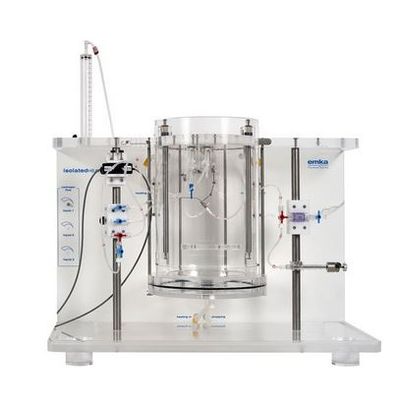
emka - Isolated Heart System
The isolatedHEART system is a versatile solution to investigate small mammalian heart function, in health and disease, or following drug challenges. It provides highly reproducible experimental conditions to ensure survival of the isolated heart during several hours, allowing the simultaneous assessment of cardiac electrophysiological and mechanical parameters (ECG, LVP, perfusion flow & pressure, etc.).
- Modular
- Easy to use
- Highly reproducibl
The same system can be used in either Langendorff or Working Heart Mode. While designed for mice and rat hearts, the system can be adapted for use with rabbits and guinea pigs as well. Multiple perfusion head designs and bubble trap sizes facilitate this adaptation across species. Various ports for instrumentation and injections are present, including electrical stimulation for pacing. Users can perfuse up to three physiological liquids. The three easily configurable perfusion mode options controlled through our automated pressure flow regulator include:
- Constant flow in aorta (Langendorff mode)
- Constant pressure in aorta (Langendorff mode)
- Constant pressure in atria, with post charge in aorta (working heart mode)
Over thirty years of Langendorff experience, emka has optimized a user-friendly interface capable of a simple transition between Langendorff and Working Heart Mode. This fully integrated system includes organized, easily accessible, and clearly labeled tubing. A sliding door opens the heart chamber that has heated walls, and limited dead volume provides optimal temperature regulation.
The ex vivo nature of an isolatedHEART study gives researchers complete environmental control (i.e. temperature, pressure, flow, perfusate, etc.) while removing the normal homeostatic regulation. This system provides nutrients and oxygen to the organ after its removal from the animal. It allows for the addition of drugs (via the perfusate) and observation of their effect on the organ without the complications involved with in vivo experimentation, such as neuronal and hormonal effects from living animal. Additionally, the researcher can control many parameters such as perfusate composition, pressure, flow, and oxygenation to create various conditions (i.e. anoxia, hypoxia, hypo/hypertensive). Obtained measurements are highly reproducible and easy to analyze.
In the Langendorff heart perfusion mode, the perfusate is pumped through the aorta towards the heart. It does not enter the left ventricle, but is diverted into the coronary arteries.
This mode permits the study of heart contraction, heart rate and vascular effects. It is ideal for the study of intraventricular pressure, cardiac contractility and relaxation, ECG and coronary flow.
Outcomes:
- Perfusion flow (coronary)
- Perfusion pressure
- Left ventricular pressure by latex balloon
- Temperature
- ECG with or without pacing, Intracardiac ECG/stimulation
- pH, pO2
- MAP, VAP (with contact micro electrodes)
- Pressure-volume loops
In the working heart perfusion mode, the flow of perfusate mimics the flow of blood in situ. The perfusate enters the left atrium via the pulmonary vein, is pumped into the left ventricle, from where it is pumped into the aorta, against a resistance that mimics the global resistance of the body.
As the name implies, this technique allows the heart to perform its physiological pumping action, i.e. it performs pressure/volume work. Therefore it provides a complete analysis of heart function and can be used for the study of cardiac metabolism, long-term pathology or ischemia-reperfusion.
Outcomes:
- Perfusion flow (coronary and aortic)
- Perfusion pressure (veinous atrial pressure)
- Afterload pressure (mimic the load created by the complete artery network)
- Left ventricular pressure by PTFE catheter
- Temperature
- ECG with or without pacing, Intracardiac ECG/stimulation
- pH, pO2
- MAP, VAP (with contact micro electrodes)
- Atrial flow with Transonic flowmeter
- Pressure-volume loops