- Home
- Companies
- Regen Lab SA
- Products
- RegenATS - Model PRP - ...
RegenATS - Model PRP -Leukocyte-Reduced Platelet Gel
The combination of RegenPRP® and RegenATS® offers different application possibilities. By adding ATS to the liquid PRP, different strengths can be achieved. In this way, Regen PRP can be brought into the optimal state and shape for the respective application. The result is a leukocyte-reduced platelet gel (platelets embedded in the fibrin matrix), which can also be used as a dimensionally stable membrane if required. The leukocyte-reduced platelet gel has adhesive properties and falls under the scope of tissue engineering.
The addition of autologous thrombin serum (ATS) to the Regen PRP physiologically starts the coagulation process and thus enables the production of a leukocyte-reduced platelet gel.
Autologous Thrombin Serum (ATS) converts soluble fibrinogen into fibrin monomers, which polymerize into a clot.
This natural process induces the formation of a three-dimensional fibrin matrix in which the platelets are embedded. This enables long-lasting growth factor delivery at the treatment site and the matrix serves as a scaffold for new tissue reconstruction.
The coagulation process is a complex cascade of reactions that causes the thrombin to convert soluble fibrinogen into insoluble fibrin molecules that form the fibrin clot. If calcium is added, this accelerates the process and the fibrin structure is strengthened.
CE2797 Preparation of autologous platelet-rich plasma (A-PRP ®)and other plasma-derived products
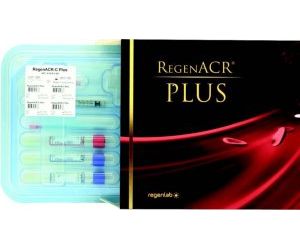
- RegenACR®Plus
- Ref: R-ACR-C/BA
- 1 Safety–Lok™ Butterfly needle
- 1 Collection holder
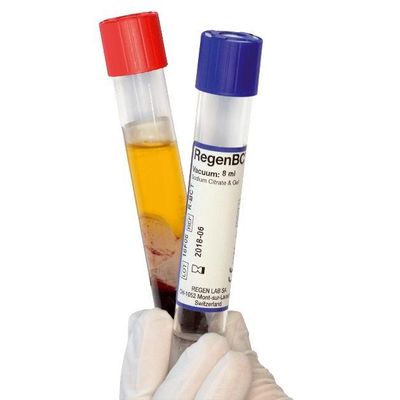
- 2 RegenBCT tubes
- 1 Transfer device
- 1 x 1 ml Luer-Lok™ syringe
- 1 x 80 mm transfer cannula
- 1 RegenATS tube
- 1 transfer needle
- 2 x 5 ml Luer-Lok™ syringes
Class IIb CE certified Medical Devices. Regen Lab SA is an ISO13485 :2016 and MDSAP certified medical device manufacturer
- Platelet dysfunction syndrome
- Critical thrombocytopenia
- Hemodynamic instability
- Severe metabolic or systemic disorders
- Septicemia
- Acute/local infection at the site of the procedure
- Patient unwilling to accept risks
- Consistent use of NSAIDs within 48 hours of procedure
- Consistent use of other medication or dietary supplement which alter platelet function, within 3 days of procedure
- Corticosteroid injection at treatment site within 1 month of procedure
- Systemic use of corticosteroids within 2 weeks of procedure
- Tobacco use
- Recent fever or illness
- Cancer- especially hematopoietic or of bone
- Autoimmune diseases with presence of antibodies and progressive (Hashimoto, rheumatoid arthritis, lupus, etc)
- Impaired coagulation
- HGB < 10 g/dl
- Platelet count < 105/ µl
Possible side effects of blood collection
Blood collection may cause damage of the blood vessels, hematomas, superficial phlebitis, delayed wound healing, early or late infection and/or temporary or permanent nerve damage that may result in pain or numbness.