


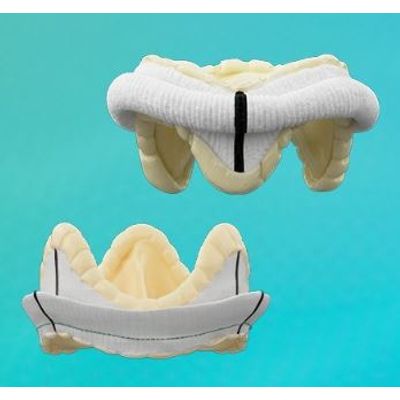
Abbott - Model EPIC Plus -Mitral and Aortic Stented Tissue Valves for Heart Valve Replacement
The Epic Plus Mitral and Aortic Stented Tissue Valves from Abbott represent the latest generation of the Epic Platform, designed for patients requiring heart valve replacement due to diseased, damaged, or malfunctioning valves. These bioprosthetic valves are engineered with advanced features aimed at enhancing radiopacity and implantability, facilitating interventions for patients with challenging anatomies. The mitral variant boasts low stent post height and unique leaflet design to prevent left ventricular outflow tract obstruction, while the aortic version is equipped to withstand high pressures during procedures like balloon valvuloplasty. Both valves incorporate Linx anticalcification treatment, potentially improving long-term valve performance and durability, though clinical validation is ongoing. The platform's design considers future-forward solutions such as supra-annular implantation and mitigation of post-implant complications, ensuring compatibility with transcatheter aortic valve replacement procedures.
The latest generation of the Epic™ Platform continues the Epic product family’s history of excellence. The future-forward design of the Epic Plus mitral and aortic valves gives you and your patients more choices when it comes to preserving long-term treatment paths.
Built on the proven legacy of its predecessors, the Epic™ Plus valve delivers everything you’ve come to expect from the Epic valve—plus significant improvements to radiopacity and implantability to enable future interventions and implantation for even the most challenging patient anatomies.
MITRAL
- Low stent post height is less likely to obstruct the left ventricular outflow tract (LVOT)1
- Epic Plus valve leaflets are not prone to forming a curtain between stent posts when opened; curtaining can result in LVOT obstruction
AORTIC
- Can withstand up to approximately 8 atm pressure during balloon valvuloplasty procedures3
- Internally mounted leaflets and low stent post height reduce coronary obstruction4
- Increased visibility at valve annulus and stent posts under fluoroscopy for transcatheter aortic valve replacement (TAVR) procedures
Surgical valve treatment for mitral and aortic valve disease
The Epic™ Plus Mitral stented tissue valve is indicated for patients requiring replacement of a diseased, damaged, or malfunctioning native mitral heart valve. It may also be used to replace a previously implanted prosthetic mitral valve.
The Epic™ Plus Supra stented tissue valve is indicated for patients requiring replacement of a diseased, damaged, or malfunctioning native aortic heart valve. It may also be used to replace a previously implanted prosthetic aortic valve.
While mitral valve repair is typically the treatment of choice to treat mitral valve dysfunction, it is not always feasible.
Considerations when selecting bioprosthestic valve candidates
A bioprosthetic mitral or aortic valve may be a recommended option for patients under the following AHA/ACC treatment guidelines7:
- Patients with a contraindication for anticoagulation therapy or an anticipated nonadherence or inability to regulate vitamin K antagonists
- Patients over 70 years of age
- For patients 50-65 years of age, there is no clear consensus on choosing a mechanical vs a tissue valve; newer-generation tissue prostheses may show greater freedom from structural deterioration, often for older patients
The Epic Platform has been proven over time and defined by strong hemodynamics, intuitive implantability, a future-forward design, and more. The platform boasts the low ventricular protrusion in all valve sizes, a flexible polymer stent, individually selected porcine leaflets to ensure optimal coaptation, and a flexible sewing cuff designed to minimize both in-implant suture drag and post-implant paravalvular leak.