


- Home
- Companies
- Olympus Corporation
- Products
- Surgical Energy Devices
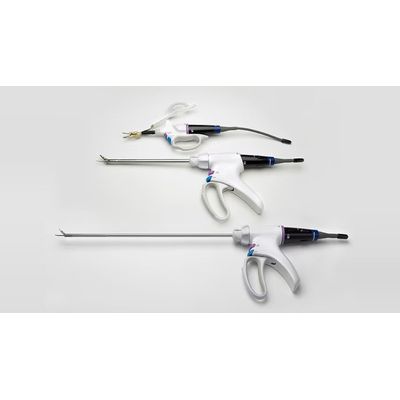
Surgical Energy Devices
Any medical device used in a life-critical situation must be perfectly designed for the doctor to manipulate at will and without concern for the device itself. This is the goal that drives Olympus to pursue perfection every time it designs a surgical energy device, or any other medical products.
Surgical energy devices are used by doctors to seal blood vessels, cut tissue and stop bleeding. They are hand-held devices, so they must be designed as if they are a part of the doctor`s own hand. Given that some surgeries can last 10 hours or more, devices must not cause the doctor any undue stress or fatigue.
When developing any medical device, Olympus designers
- simulate surgical procedures and
- strive to identify every potential problem. Only when this process has been thoroughly exhausted is the
- beta version fabricated and then
- provided to doctors to receive their feedback.
To simulate a surgery, a human body replica is placed on a height similar to a surgery table and members of the design team perform the roles of doctors and assistants in a mock surgery covering from preparation to completion. Critical factors are carefully examined during the trial, such as the device`s ease-of-use and its capacity to minimize doctor fatigue. If any issue arises, a solution must be devised and implemented. Then, once every potential issue has been addressed, the beta device is fabricated and finally released to doctors to obtain their feedback. If needed, the last three steps are repeated as many times as it takes to resolve all remaining issues and arrive at the perfect design.
When Olympus first develop its surgical energy devices, a number of candidate designs were examined before settling on two highly practical solutions — a scissors-type and pistol-type device for open surgery and a pistol-type device for laparoscopic surgery [1].
Devices, especially for open surgery, must not hinder the doctor`s line of vision. So once we determined the basic profile, we identified everything about the design that was absolutely necessary, and then eliminated any other design feature that wasn`t essential. The result was the smallest-possible profile, one that minimized any obstruction of the doctor`s view, thereby contributing to the most seamless and stress-free design possible.
Since Olympus products are used around the world, we also had to ensure that our universal designs would suit almost any size of hand. Numerous mockups were created to incorporate minor adjustments, understanding that a perfect design requires a delicate balance of features.
[1] Whereas open surgeries involve one large incision, laparoscopic surgeries use several small incisions just large enough to insert surgical instruments or devices. The latter, which generally has less impact on patients, has been gaining popularity since the 1990s.
We have clear reasons for every design feature incorporated into our surgical energy devices. Looking at the handle, for example, there are two buttons — one for transecting (detaching) tissue and one for sealing blood vessels to prevent bleeding. Button pressure had to be ideally balanced between smooth, fatigueless operation and necessary resistance to prevent unintended actuation. In addition, we had to ensure that the doctor could easily distinguish between the two buttons while staring at a monitor, so not only did we use different colors, we placed distinguishing tactile bumps on one of the buttons.
Even the angle of the handle is highly significant. The pistol-type device is available in two versions, one for laparoscopic surgery and one for open surgery. The shapes appear to be the same, but in fact the handle angles are slightly different to ensure optimal user-friendliness with respect to the procedural differences between laparoscopic and open surgeries.
The device`s surface texture is crucial too. Since blood, fat and tissue tend to adhere to surgical instruments, the devices must have smooth, stick-resistant surfaces, but not to the point where they could slip in the doctor`s hand during delicate, high-precision procedures.
For certain other surfaces, however, we intentionally made them extra smooth. For example, while the trigger of the open-surgery device is both rubberized and texturized on its inner edge and part of its outer edge for flexible control, the lower outer edge was made extra smooth without using rubber. We chose this design after confirming that a rubberized trigger surface can unintentionally grab the surgical drapes and interfere with the surgery. For the laparoscopic-surgery device, moreover, the trigger`s entire outer edge is non-rubberized because of the greater chance of contacting surgical drapes in such surgeries. Every detail, no matter how small, was carefully considered prior to finalizing any design.