

- Home
- Companies
- Federal Signal Corporation
- Products
- Federal Signal - Model SSM - ...
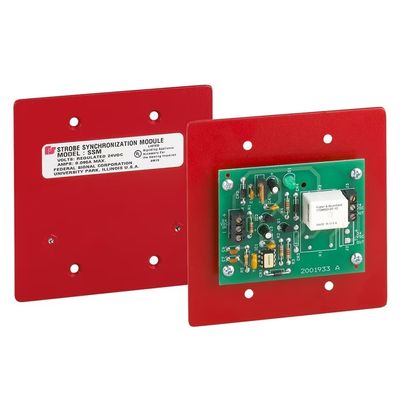
Federal Signal - Model SSM -Synchronous Strobe Module
The Model SSM, Synchronous Strobe Module, is an electronic timing mechanism designed to energize select Federal Signal low in-rush 24 Vdc strobe lights while maintaining the ability to remotely supervise the light circuit. This module is designed to synchronize a special series of Federal Signal lights, which meet the requirement for Private-Mode Fire Alarm use, while maintaining the agency approval and environmental rating of the light. The SSM is only compatible with Federal Signal brand strobe and LED lights. See related models at the bottom of this page.
- Synchronizes strobe lights to 72 flashes per minute
- Mounts on double-gang electrical box
- UL1971 Approved for hearing impaired applications
- Polarized design allows for remote supervision
- Compatible with select Federal Signal model strobe lights (see chart)
The SSM enables the customer to meet local building codes through a visually appealing “single-flash” created by the simultaneous control of lights connected to it. Mixed signals are reduced to a minimum as reflection of many light pulses are now viewed as one single flash.
The SSM mounts to the plaster ring of a double-gang electrical box and requires 24 Vdc at all times to operate the timing circuit. Screw terminals are provided for field termination of control wiring (reference drawing for details). Electrically, the SSM should be mounted in the middle of the circuit, with a maximum cable distance of 100' from the SSM to each light. Supervision is accomplished the same as without the SSM, with a flash rate of 72 flashes per minute in lieu of the advertised flash rate for each light. The SSM is capable of switching 6 A of current. Please note: Not all strobe lights have the same in-rush current; and therefore, the SSM's circuit's switching potential may be reduced. Please see the application drawings on the second page.