


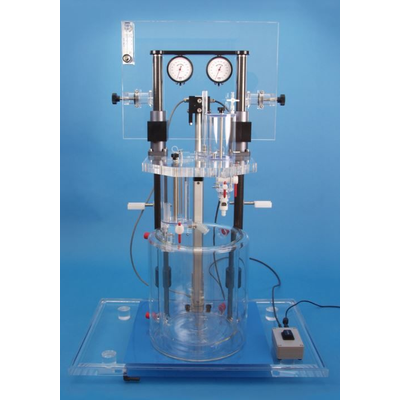
Hugo Sachs - Model IH-9 -Tabletop Isolated Heart Perfusion System
Each IH-9 system is quoted to meet the specific requirements of the researcher. Additional components are required for a fully functional system. Add the Working Heart Option to upgrade to a working heart system.
The IH-9 system is a tabletop isolated heart perfusion system developed for small pigs with a body weight up to about 20 kg. It can also be used for rabbit or mini pig models. The IH-9 offers ultimate perfusion stability and real physiological conditions for longer, more relevant recordings with fewer artifacts.
The modular nature of the IH-9 allows the system to evolve along with your research. Our Langendorff system can easily be upgraded to full working heart system. Both Langendorff and working heart modes allow a choice of measurement capabilities with dedicated packages available for specialized applications, such as measurement and analysis of multiple ECG and MAP signals. Perfusion of such larger hearts also creates the opportunity for detailed study of cardioplegia solutions and reperfusion after cardioplegia. Infarct studies with reperfusion and many other studies similar as on smaller hearts are possible.
- Advanced System Design
- Applications
- Features & Benefits
- Measured Signals & Calculated Parameters
- Required Core items
Additional Components - Specialized Applications and Upgrades
The IH-9 utilizes the proven architecture and functional principle of our smaller IH-5 system but is engineered for the increased flow produced by these larger species. The system can be operated in any one of the three modes: retrograde Langendorff perfusion under constant pressure, retrograde Langendorff perfusion under constant flow, and real ejecting working heart. The IH-9 allows standard hemodynamic as well as ischemia-reperfusion studies using saline or erythrocyte-containing perfusion solutions or real blood (heparinized). Saline perfusions will not be optimal as the O2 transport in saline solution is not sufficient enough for these large organs.
The key part of the system is the unique aortic block, which is mounted on the cover of the heart chamber. In the working heart setup, the preload reservoir is also mounted on the bottom of the cover and consequently in the heart chamber. All other components are mounted on the main heart cover chamber, except for the pumps, the oxygenator, the thermostatic circulator and the PLUGSYS amplifier system.
The large Windkessel acts as bubble trap and damping reservoir in retrograde Langendorff perfusion and mimics the compliance of the aorta in ejecting working heart perfusions. Special attention has been made to ensure that all critical connecting tubing are short, thus avoiding any cooling to ambient temperature through a temperature gradient and any system generated flow resistances.
A large threaded spindle syringes on the right sets aortic pressure in retrograde Langendorff perfusion or the afterload pressure in ejecting working heart. The second threaded spindle syringe on the left side sets the preload pressure (left atrium pressure) in working ejecting heart perfusions. The patented membrane system where these syringes are connected avoids high bouncing water columns. Thus the measured pressure waves mimic in vivo pressures situation as near as possible.
The large 6 L heart chamber also acts as reservoir to keep blood or perfusion solution volume as small as possible. Perfusate that contains erythrocytes is oxygenated by a special membrane oxygenator. The connection to the heart is made through interchangeable aortic cannulae and atrial cannulae in the working heart extension. The entire setup is on a platform with an electrical-driven lift that moves the platform up and down. The complete platform with the attached heart can be lowered with the lift so that the heart hangs in the heated jacketed heart chamber to get better temperature conditions for the heart.
The system can accommodate hearts with aorta diameters from 5 to 12 mm. For retrograde perfusion, perfusion pressure may be up to 300 mmHg and perfusion flow up to 500 ml/min. In working heart mode, the special flow resistance and compliance chamber closely mimics the in vivo afterload. Aortic flow up to 1,500 ml/min is possible.
- Study of myogene autoregulation with the addition of ultrasonic flow measurement (TTFM-2 and suitable flow probe)
- Testing inotropic substances
- Testing of lusitrope substances
- Testing of vasoactive substances
- Cardiac rhythm tests
- Ischemia/hypoxia studies
- Refractory period studies
- Ischemia/reperfusion injury studies
- Cardioplegia studies
- Cardiac preconditioning
- Cardiovascular screening performance
- Electrophysiology studies (ECG, Monophasic Action Potentials)
- Phenotyping of transgenic animals
- Drug compound screening
- Toxicology studies
- Biochemical tests
- Heart transplantation models
- In-depth hemodynamic applications including study of cardiac flow, LVP and pressure-volume relationships
In addition, in working heart mode:
- Real-time measurement of aortic and atrial flow
- Intracardial left ventricular pressure (LVP) measurement
- Pressure-volume measurement
- High atrial pressure-induced disease state simulation
Langendorff Mode
- Low flow resistance and dead space volume, minimize perfusion artifacts
- Compact system does not require high water columns
- Suitable for hearts from hypertensive animals (perfusion pressure up to 300 mmHg is possible)
- Constant pressure or constant flow in one unit
- Unique integrated aortic block
- Bubble trap located immediately above the aortic cannula
- Integrated flow probe option for accurate real-time flow measurement
- Integrated stopcock to control perfusion flow and simulate ischemic conditions
- Drug injection pathway built directly into aortic perfusate stream
- Temperature and oxygen loss minimal
- Easily upgraded to a working heart system
- Modular system grows with your applications
- System specific electrodes and holders for precise measurements
- All electrodes, catheters etc. are placed around the heart to have easy and direct access
Working Heart Mode (in addition to all Langendorff features)
- Optimized atrium cannulating conditions
- Easy to switch from the Langendorff mode to the working heart mode and back
- Physiological flow resistance and minimal dead space volume
- Short atrial fill time (low flow resistance) resulting in optimal ventricle filling
- Built in port for insertion of a catheter transducer for left ventricular pressure or pressure-volume measurement
- Mimic physiologic atrial and arterial pressure and flow patterns
- Compact aortic block
- Exclusive patented Membrane Afterload System and compliance chamber, mimic physiological cardiac afterload and avoid damage to heart valves that occurs with water column-based systems
- Integrated flow probe option for accurate real-time aortic flow measurement
- Real constant preload system
- Mimics physiologic atrial pressure patterns
- Reduced stress on mitral valve caused by the pump
- Preload pressure independent of the atrial flow
- Real time coronary flow measurement (option)
- Coronary flow can be measured directly by cannulation of the pulmonary artery
Measured Signals and Calculated Parameters
The following signals are recorded as raw data in retrograde Langendorff perfusion:
- Isovolumetric left ventricular pressure (balloon method)
- Aortic (perfusion) pressure
- Coronary flow*
The following parameters are calculated from the raw data (using the ISOHEART data acquisition software):
- dLVP/dt, dLVP/dt Max, dLVP/dt Min, Contractility Index
- Systolic and diastolic LVP
- Heart rate
- Mean perfusion pressure
- Mean perfusion Flow*
- Coronary resistance*
* This parameter is based on indirect flow measurement with the SCP controller or direct ultrasound flow measurement with the TTFM-2 flowmeter and suitable flow probe.