


- Home
- Companies
- Mavera Medical Devices Inc.
- Products
- Mavera MYTHICA - Ultrasonic Thrombosis ...
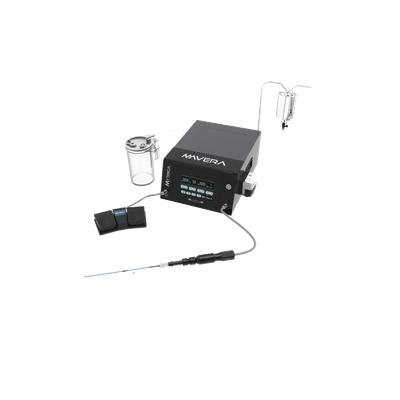
Mavera MYTHICA - Ultrasonic Thrombosis Cavitation System
The Mythica Ultrasonic Thrombosis Cavitation System is designed for the percutaneous treatment of blood clots within the peripheral vasculature, utilizing ultrasound technology for minimal invasive surgery. The system features an external power generator, a piezoelectric handle, and an ultrasonically driven catheter. Acoustic cavitation occurs, creating microscopic bubbles that exert substantial pressure to disrupt thrombi. Ultrasound application during thrombolysis aids by enhancing lytic agent contact with plasminogen receptor sites, facilitating clot breakdown. Operating in the 20-100 kHz range, the system converts electrical energy into high-power ultrasonic energy using PZT crystals, providing effective intravascular clot removal via fragmentation, emulsification, and aspiration. Suitable for trained surgeons, it offers a comprehensive solution for thrombus management in peripheral arteries.
- Superior Thrombus Clearance
- Increased Drug Uptake
- Reduced Lytic Agent Dose
- No Hemolysis
- No Vessel or Valve Damage
Mythica™ Ultrasonic Thrombosis Cavitation System is intended to be used in selectively fragmentation, emulsification, irrigation and/or aspiration of soft tissues (e.g., blood clot (thrombus) in the peripheral vasculature) percutaneously. The system comprises an external power generator, a piezoelectric Ultrasonic Piezo Handle, and an ultrasonically driven catheter.
Acoustic cavitation is the formation of vapor-filled “cavities” or microscopic bubbles in a liquid affected by the alternating pressure of ultrasonic energy. The collapse of these microbubbles generates high local pressure charges of up to 28,000 atm that disrupt the target thrombus. The size of the microbubbles is inversely proportional to the frequency of ultrasonic energy. The larger bubbles of lower ultrasound frequencies are thought to produce greater force. A study of the effect of ultrasonic frequency on thrombus disruption showed an inverse logarithmic relation between frequency and thrombus disruption. 6
Ultrasound when applied to the thrombosed vessel during thrombolysis enhances the thrombolytic process by accelerating the contact of the lytic agent with plasminogen receptor sites within the thrombus. Acoustic microstreaming created by the ultrasound pulses augments the transportation of the lytic agent, disseminating it throughout the clot. The energy transmitted by the ultrasound waves also separates/loosens the fibrin strands, increasing the surface area of the thrombus and making more plasminogen activator receptor sites available to the lytic agent.