


Version Type 7771 -Software for CPB and Overall Level Analysis
Real-time, standardised digital filter-based analysis using 1/1, 1/3, 1/12 and 1/24 octaves for analysing noise, determining sound power levels, sound intensity measurements, and machine vibration monitoring.
- Sound level meter - octave spectrum
- Leq logging - sound levels vs. time
- Sound intensity - pure tone location while measuring
- Reverberation time calculation - using a loudspeaker or gunshot
- Machine vibration level monitoring - including pass/fail tolerance check
- Smart Start – quick three-step start-up guide
- CPB 1/n-octave analysis up to 1/24-octave
- Multi-buffer spectrum logging
- Linear - leq logging
- Exponential averaging – including slow and fast
- Exponential confidence level averaging for accurate measurements
- Exponential minimum and maximum hold
- Gated CPB analysis
- Frequency weighting A, B, C,and D
- Mean pressure, particle velocity and sound intensity calculation, and complex intensity calculation
- Reverberation time calculation supporting interrupted and impulse method
- Response equalisation - allowing use of the same microphone in different sound fields (free-field, pressure field and random)
- Advanced signal generator support with CPB sweep
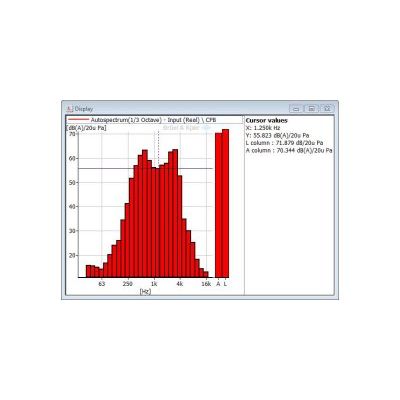
Type 7771 is PULSE’s base software for CPB (1/n-octave) and overall level analysis with simultaneous measurement of exponential, linear, impulse and peak levels. Type 7771 provides general noise testing using real-time, multi-channel analysis as well as general R&D, noise analysis using several analyzers and multiple frequency spans simultaneously. Type 7771 also provides the possibility to monitor vibration levels from rotating machinery, including pass/fail tolerance level check.
With user-definable measurement solutions, all basic requirements, including data acquisition, calibration, measurement, analysis, post-processing and reporting are convenient and manageable.
CPB – 1/n-octave Analyzer
PULSE’s constant percentage bandwidth analyzer provides real-time standardised digital filter-based analysis using 1/1, 1/3, 1/12 and 1/24 octaves. This 1/n-octave analysis is often preferable to FFT analysis when analysing noise. The real-time CPB analyzer can be used, among other things, for the determination of sound power levels and intensity measurements. CPB filters fulfil the requirements of IEC 61260–1995 Class 1, DIN 45651, ANSI S1.11–1986 and ANSI S1.11–2004.
CPB – Vibration Monitoring
CPB analysis is also favourable to FFT when monitoring vibration levels from rotating machinery. With change in rotational speed, first and all higher orders will change accordingly. The relative frequency change of the higher orders is a multiple of the first order change. Small speed variations can cause large frequency shifts on higher orders, crossing FFT bands. This makes level monitoring within one FFT frequency band impossible. CPB 1/24-octave analysis overcomes this problem, as the bandwidth naturally gets larger, higher order frequency shift is kept within the same CPB band. This allows monitoring the vibration level for particular orders and defining pass/failing criteria for excessive vibration levels.
Overall Level Analyzer
For characterising your noise or vibration signals, there is an overall level analyzer, which performs a broadband analysis. When measuring sound, this analyzer is equivalent to a sound level meter and fulfils selected, relevant requirements of IEC 651, IEC 61672 and IEC 60804 for a class 1 instrument.
Powerful Analysis Capabilities
- Real-time CPB measurements on over 100 channels
- Multi-analysis allows multiple analyses of the same input data, reduces test and reporting time, and ensures consistency of data, for example:
- Simultaneous analysis using CPB analyzer and overall level analysis with different detection settings such leq and peak
- CPB 1- and 1/3-octave analysis of the same data
- Real-time signal analysis using the PC’s CPU:
- CPB 1/3 octave analysis on 16 channels to 25.6 kHz bandwidth (typical PC 2 GHz dual core)
- CPB 1/3 octave analysis on 64 channels to 25.6 kHz bandwidth (high end PC 2,2 GHz i7 quad core)
- Powerful signal generator, providing a host of sine, random, CPB sweep and user-definable waveforms (requires hardware module with generator support, see BP 2215 or BU 0228).
- Reverberation time calculation supporting interrupted and impulse method - PULSE averages the measurements for each channel of each configuration, calculates the reverberation time for each of the averages, and finally calculates and displays the mean reverberation time for all measurements as a 1/3-octave spectrum
Smart Start
Now it is easier than ever to start and operate PULSE. With Smart Start, PULSE configuration and project setup is performed in just a few steps.
- Quick three-step start-up for new projects - select the default new project template, click start and start measuring
If a more advanced setup is required, the user interface’s organiser windows provide access to all analyses and function properties available in PULSE.
Response Equalisation
Response equalisation eXtreme (REq-X) allows you, in real-time, to effectively equalise the frequency response of a transducer to a flat response. This applies to both accelerometers and microphones. REq-X is performed by filtering the time signal of a transducer by the inverse of the frequency response. When applicable, the equalisation can be performed in both phase and magnitude.
- Expands the high accuracy frequency range for transducers
- Extends the usability of existing transducers
- Use of the same microphone in different sound fields (free-field, pressure field and random) with various accessories can be compensated
- Microphone correction using the frequency response functions found in the transducer database
- Increase frequency range for accelerometers by up to 50%
- Automatic detection of the accelerometer frequency response via TEDS
Post-processing
The following post-processing can be applied to a CPB measurement:
- Phase-assigned autospectrum
- Frequency response function (H 1, H 2, H 3)
- 1/Frequency response function (1/H 1, 1/H 2, 1/H 3)
- Coherence
- Signal-to-noise ratio
- Coherent/non-coherent power
- Calculated intensity/complex intensity
- p-I index
- Loudness (ISO 532 B)
- Articulation index (ANSI 53.5–1969)