


- Home
- Companies
- Vacumetrics Inc
- Products
- Cold Air Challenge Test System
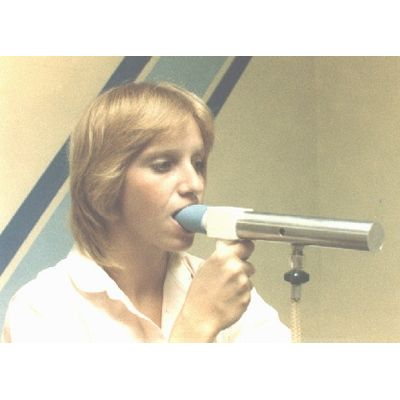
Cold Air Challenge Test System
Model "TurboAire Challenger" A cold air generator for cold air challenge testing. The TurboAire Challenger is a cost effective substitute for drug induced bronchospasm. Since no drugs or chemicals are administered, the patient risk is lower. The patient needs to be monitored for only one-half hour following the conclusion of the exposure to cold air, not the 2 to 4 hours suggested for drug related brochial provocation methods. The TurboAire Challenger is an excellent source of portable arctic air for pronchial provocation and Exercise Induced Asthma studies throughout the year. Perform bronchial challenge using cold air, without the wait or worry associated with obtaining methacoline. Schedule tests when convenient. The TurboAire Challenger supplies cold air any time, anywhere. The TurboAire Challenger has been marketed since 1984 and is preferred by research and clinical personnel to provide cold air for bronchial challenge.
- Low temperature: -20 degrees C
- Lightweight: 17 ounces
- Instant cold dry air
- Ease of use with either exercise or isocapnic hyperventilation
- Operates on compressed air from tanks
- No electricity, chemicals, or liquids
- No maintenance
- Low cost, economical operation
- Adult and pediatric mouthpiece options
The purpose of performing bronchial provocation studies of any kind is to document the presence or absence of a physiologic response to a specific stimulus. The most common form of testing is done using a chemical or drug stimulus (Histamine, Methacholine, Formaldehyde, etc) which the patient inhales. These techniques are good for industrial or allergic asthma evaluation.
Exercise induced asthma (EIA) is a specific response and has been attributed to loss of water vapor from the airway, coupled with a thermal (cold) stimulus. To evaluate this specific response, it is necessary to produce a specific stimulus to cold, dry air. Until now, cold air generators worked with either copper coils immersed in a bath of acetone and dry ice or alcohol and dry ice or a heat exchanger from a freon refrigeration system. The patient inspires air through the coil with temperatures in the -5 to -10 degree C range. Both these methods require bulky systems which are difficult to get near the patient and the chemical based coolers have the added potential hazard of the patient inhaling the cooling solution vapors.
The turboaire challenger is the first system to offer absolute cold and dry inspired gas in a in a small package which can be easily brought to the patient on a treadmill or ergometer. It has no moving parts and uses no chemicals. The total flow available to the patient is approximately 240 liters/minute of air at -10 to -15 degrees C.
The temperature is controlled by pressure regulator (80 to 110 psig) and the inlet gas temperature is reproducible to within 0.6 degree C. Due to the relatively high pressures and total flow required, hospital piped air systems are insufficient to operate the Challenger at sub-zero temperatures. Operation using wall air is possible with some reduction in temperature differential and total flow. The cost to hospitals for an "H" or "K" cylinder of compressed air ranges from $7.00 to $10.00, maintaining a low cost per test. Testing time per cylinder ranges between sixteen and twentyfour minutes depending on tank and temperature selection. The standard system uses 375 liters of air per minute. 35% of this is used to cool, resulting in 244 liters/min being deliverd to the patient.
Most protocols call for breathing the cold air for 6 to 8 minutes at 60 to 80% predicted maximum work. There are no valves in the mouthpiece block and it is made of natural acetyl. There is a 10-32 threaded port at the top of the block for placement of a temperature probe or a hose barb for a CO2 line.
Standard Turboaire Challenger includes the cold air generator, breathing block and pediatric and adult mouthpiece adapters in a permanent carrying case. For standard cold air provocation tests you will also need a high pressure hose (No. 2009-1) and high flow regulator (No. 2009-4). A standard ventilator supply hose can be used as a high pressure hose.