


- Home
- Companies
- SCIREQ - an emka TECHNOLOGIES Company
- Articles
- Extending Donor Lung Viability: ...
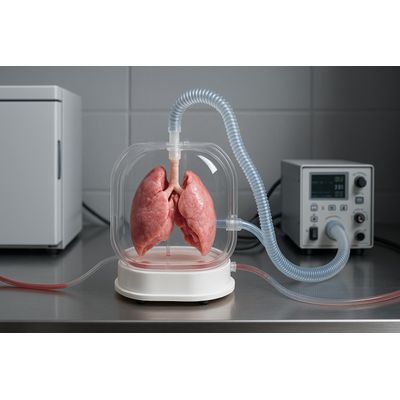
Extending Donor Lung Viability: Ventilated Preservation at 10°C Improves Murine Donor Lung Function
In a preclinical study published in Scientific Reports, Hill et al. evaluated whether sub-normothermic storage at 10°C with continuous, low-volume ventilation could extend donor-lung viability in a murine model.
Study design
Over a 24-hour preservation period, three methods were compared: static storage at 4°C, static storage at 10°C, and 10°C storage with continuous, low-volume ventilation.
Key findings
- Reduced lung injury: decreased cellular apoptosis and tissue damage.
- Improved mitochondrial health: lower oxidative stress within lung cells.
- Decreased complement activation: reduced immune responses linked to early graft dysfunction.
- Enhanced respiratory mechanics: lower airway resistance and higher lung compliance.
Assessment with flexiVent
Post-storage assessment employed the flexiVent system to quantify pulmonary mechanics via the Forced Oscillation Technique, measuring airway resistance, dynamic compliance, tissue elastance and damping, and associated pressure–volume relationships.
Results indicated ventilated lungs stored at 10°C had significantly lower airway resistance and better compliance than statically stored lungs, supporting the preservation approach.
Implications for preclinical transplantation research
These findings support combining moderate hypothermia with physiologic ventilation to extend donor-lung viability. Platforms like flexiVent provide sensitive, reproducible respiratory mechanics measurements essential for translating cellular improvements into quantifiable preclinical outcomes.
Reference
Hill MA, Tennant M, Watts B, Atkinson C, O’Neil R, Engelhardt KE, Gibney BC. Evaluation of ventilation at 10 °C as the optimal storage condition for donor lungs in a murine model. Sci Rep. 2026;16(1):7228.
Original: https://www.scireq.com/extending-donor-lung-viability/